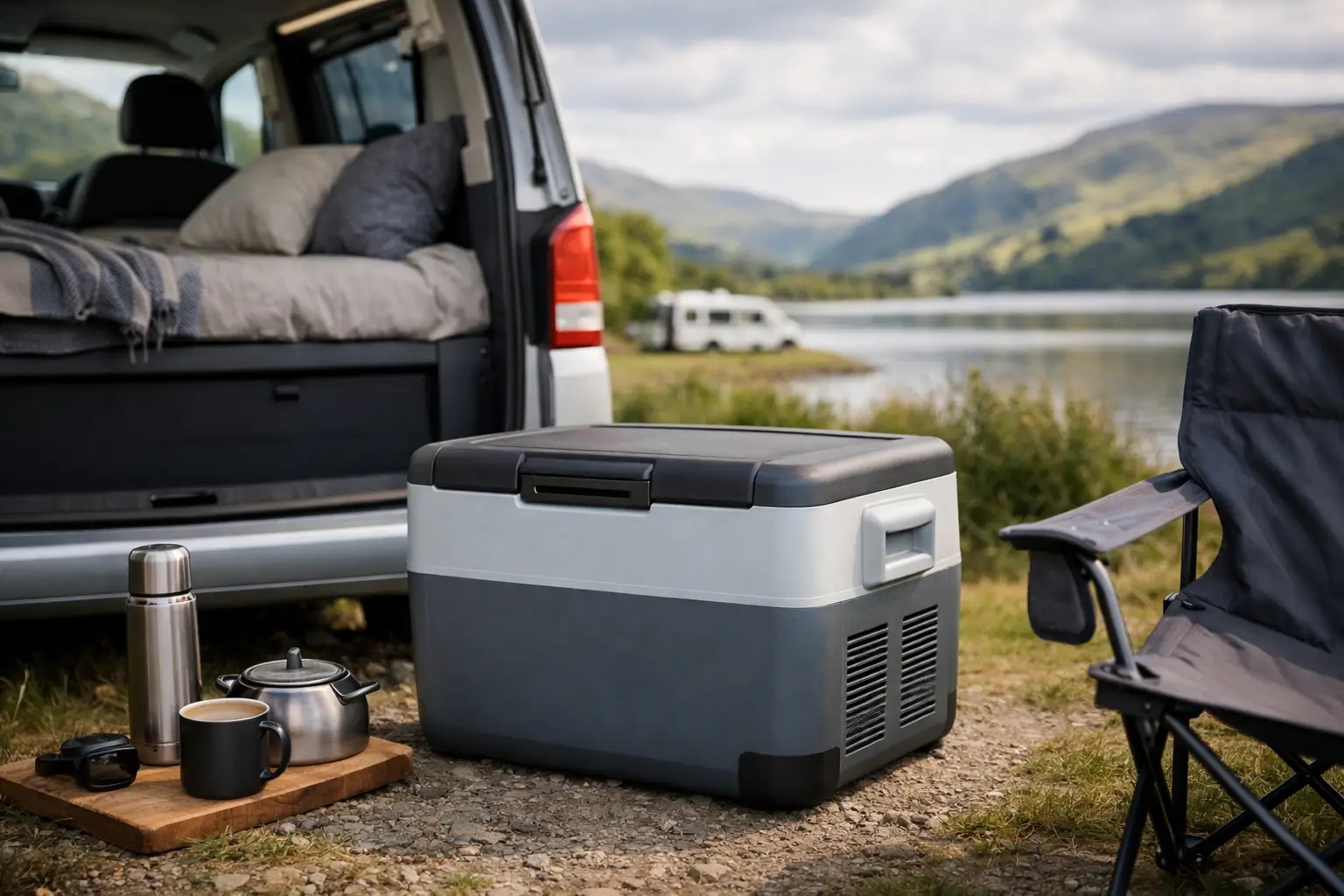
A coolbox that is brilliant for a day at the beach can be frustrating on a week in the campervan. It may be too tall for its cupboard, drain the leisure battery overnight or simply fail to keep milk properly cold during a warm stopover. Knowing how to pick a campervan coolbox starts with your own touring routine, not the biggest capacity or the lowest price.
For many UK campervan owners, the right choice makes food shopping easier, reduces reliance on daily shop runs and keeps picnic supplies ready whenever the weather turns in your favour. The key is balancing cooling performance, power use, available space and the way you like to travel.
Choose the right type of campervan coolbox
The first decision is whether you need a passive coolbox, a thermoelectric model, a compressor coolbox or an absorption unit. They may look similar at first glance, but their performance and suitability for campervan life are very different.
A passive coolbox uses ice packs and insulation only. It is light, quiet and does not need any power, making it useful for beach days, short picnics and carrying chilled food from the campsite shop. However, it is not a practical replacement for a fridge on a multi-day tour. Once the ice packs have warmed up, so has your food.

Compact 15L compressor fridge-freezer that runs happily off 12V, keeping food and drinks properly chilled or frozen on the pitch without hogging space. Fast cooling, quiet operation and dual 12/24V DC & 110–240V AC inputs make it ideal for caravans, motorhomes and towcars.
Power Options: 12/24V DC and 110–240V AC compatible
Cooling Range: -20℃ to 20℃ with rapid chill function
Pitch Practicality: Low noise, battery protection, compact 15L footprint
A thermoelectric coolbox is usually the budget-friendly powered option. It plugs into a 12V socket and often mains electricity with an adaptor. These models generally cool to a set number of degrees below the surrounding temperature, rather than holding a precise fridge temperature. That can be perfectly adequate in mild British weather, but on a hot sunny day inside a van, performance can drop away. They also tend to run continuously, which matters if you are not hooked up.
Why compressor coolboxes suit longer touring
For regular campervan holidays, a compressor coolbox is often the strongest all-round choice. It works much like a domestic fridge, can maintain a chosen temperature and many models can freeze food as well as chill it. Crucially, it is far less dependent on the outside temperature.
Compressor models cost more and are usually heavier, but they are a sensible investment for off-grid stays, longer breaks and anyone carrying fresh food, medication or drinks for the whole family. Look for a model designed for 12V use, ideally with 24V and mains capability too. This gives you flexibility in the campervan, at home before departure and on electric hook-up pitches.
Absorption coolboxes can run on gas, 12V and mains electricity. Their quiet operation appeals to some campers, but they need to be kept level and can struggle in high temperatures. They are worth considering in the right set-up, particularly where gas operation is useful, but a compressor coolbox is generally easier to live with in a moving campervan.
Work out the capacity you will actually use
Coolbox capacity is normally given in litres, but the best size depends on who is travelling and how often you restock. A compact 15 to 25-litre unit can suit solo travellers, couples on weekend breaks or vans with very limited storage. It has room for essentials, but you will be shopping more often.
For two people touring for several days, around 30 to 40 litres is a practical sweet spot. It can hold milk, breakfast supplies, chilled meals and a few drinks without taking over the living area. Families, longer off-grid travellers and keen outdoor cooks may prefer 45 litres or more, especially if the coolbox will be the main fridge.
Bigger is not automatically better. A large coolbox is harder to lift, needs more floor or garage space and invites you to pack more than you need. It may also be awkward to secure safely. Before buying, measure the intended location with the lid open as well as closed. Check doorways, seat bases, slide-out kitchens and the route from the rear doors to the kitchen area.
A top-opening coolbox is efficient because cold air stays inside when opened, but it needs overhead clearance. A front-opening portable fridge can be easier to organise in a fixed location, though it may not suit every layout. Also consider whether you need to access it from inside the van on a rainy evening, rather than only from the rear or side door.
Check power consumption before you travel off-grid
A powered coolbox should work with your electrical set-up, not dictate it. This is especially important if you enjoy quieter sites, festival weekends or overnight stops without electric hook-up.
Compressor coolboxes cycle on and off as needed, so their real-world consumption is lower than their maximum rated draw suggests. Even so, hot weather, frequent opening, a full load of warm food and poor ventilation will increase battery use. Look for daily energy consumption figures where available, rather than comparing watts alone.
Battery protection is a valuable feature. A low-voltage cut-off prevents the coolbox from flattening the leisure battery to the point where you cannot run lights, a water pump or other essentials. Choose a model with adjustable battery protection if possible, particularly if your campervan has a modest battery bank.
A 12V coolbox should normally be connected to a suitable dedicated socket or wiring circuit, rather than an overloaded splitter. If you have solar charging, it can make a real difference during bright summer touring, but do not assume a small panel will cover every demand. Your battery capacity, solar output, season, shade and other appliances all affect the result.
For campsite stays, mains operation is convenient and saves leisure battery power. A coolbox with 12V, 24V and 230V mains options gives you the broadest choice. Keep the relevant leads tidy and protected, and never run a mains cable through a door where it can be trapped or damaged.
Think about noise, ventilation and everyday access
Noise is easy to overlook in a showroom or online listing. In a compact campervan, a compressor switching on at night can be noticeable if the coolbox is beside the bed. Most modern units are manageable, but reading the stated noise level and positioning it well can improve comfort. A thick, stable mat may also reduce vibration, provided it does not block ventilation.
Every powered coolbox needs airflow around its compressor or cooling vents. Do not wedge it tightly into a cupboard unless the manufacturer confirms the installation requirements. Poor ventilation makes the unit work harder, use more power and potentially shorten its life.
Practical details matter too. A strong lid latch is useful on bumpy roads, while internal baskets stop smaller items disappearing to the bottom. An internal light is genuinely handy after dark, and a drain plug makes cleaning easier. Digital temperature control gives more confidence than a simple hot-and-cold switch, especially if you are carrying food for several days.
Match the coolbox to your campervan holidays
If your campervan is used mainly for weekend breaks on serviced sites, a compact thermoelectric coolbox may offer good value and enough convenience. Pack it cold, keep it shaded and use hook-up when available.
If you tour for a week or two at a time, cook in the van and like the freedom of stopping away from campsites, a 30 to 45-litre compressor coolbox is likely to repay its higher upfront cost. It offers dependable chilling, better food storage and fewer compromises when the weather warms up.
For families, consider whether one large coolbox is genuinely the easiest arrangement. Sometimes a fixed campervan fridge for daily food plus a smaller portable coolbox for drinks, extra groceries or day trips works better. It also means children can reach drinks without repeatedly opening the main food supply.
The best campervan coolbox is the one that fits your van, your power system and your usual style of touring. Choose for the holidays you actually take, leave room for ventilation and secure it properly before setting off. Then you can spend less time hunting for fresh milk and more time enjoying the view from your next pitch.