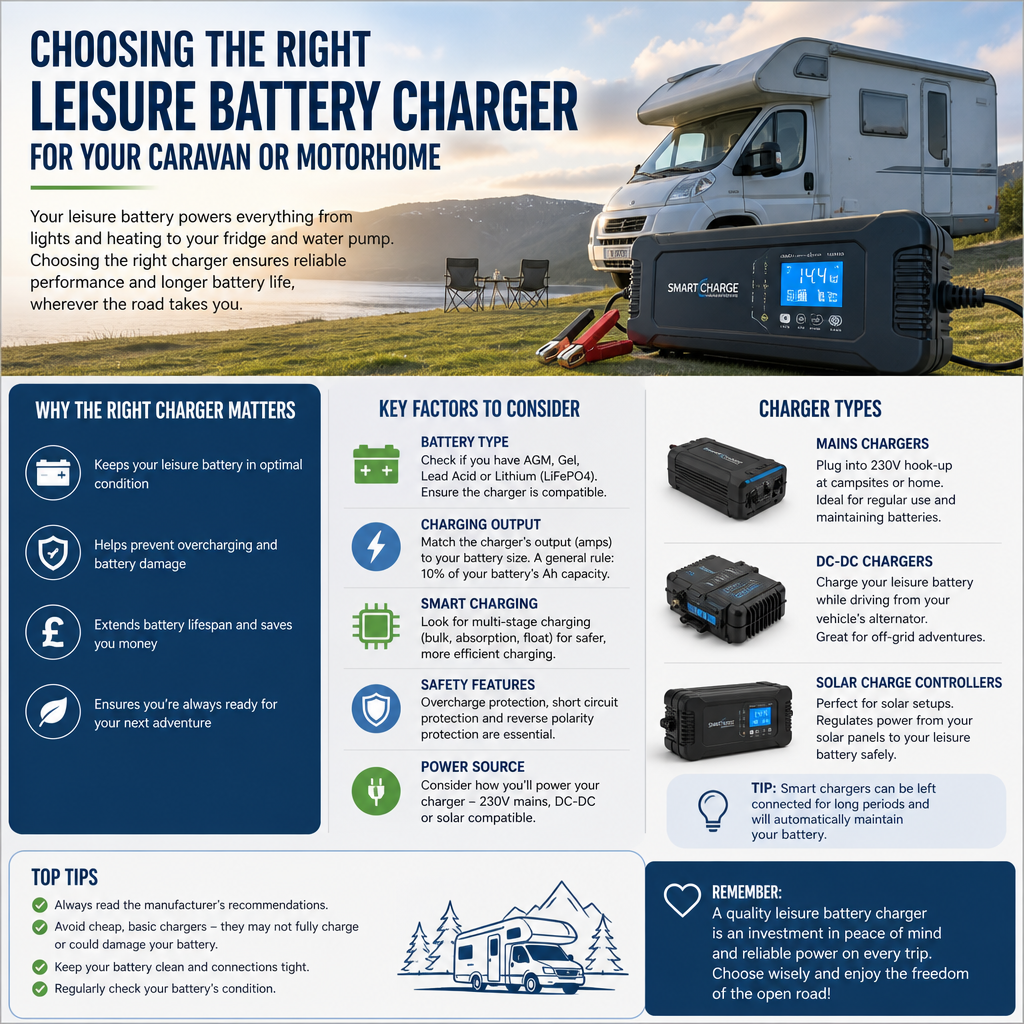
Heading off in your caravan or motorhome should feel like freedom, not a battle with flat batteries and flickering lights. At the heart of your onboard electrics is the leisure battery, quietly powering everything from your lights and water pump to phone chargers and the TV.
A leisure battery is different from the starter battery under your bonnet. The starter battery is built to deliver a big burst of power for a few seconds to crank the engine, then it is quickly recharged by the alternator. A leisure battery is designed to release energy slowly over many hours, then be recharged again, over and over, during your trips.
Most modern leisure setups use one of three battery types: traditional flooded lead acid, AGM (Absorbent Glass Mat) or lithium (LiFePO4). Each works a little differently, needs different charging voltages and reacts differently if overcharged, undercharged or left sitting for long periods.
This is why the right charger matters so much. A good match between charger and battery type means faster, more complete charging, longer battery life and safer operation. The wrong charger might still “work”, but it can quietly shorten your battery’s life, reduce its usable capacity or even cause overheating.
Whether you enjoy the odd weekend on hook up, love off grid camping on a CL or aire, or tour for months at a time, a suitable charger is just as important as choosing the battery itself.
In the rest of this guide we will break down charger types, key features and simple rules so you can confidently choose, or check, the right charger for your own setup.
Know your battery: lead acid, AGM and lithium explained
Before you can pick a charger, you need to know what it is feeding.
Traditional flooded lead acid batteries are the old faithful of leisure power. Inside are lead plates sitting in liquid acid. They are relatively cheap, widely available and quite forgiving, but they need ventilation and, on some models, topping up with distilled water. You will often find them in older caravans and budget setups.
AGM (Absorbent Glass Mat) batteries are still lead acid, but the acid is held in a fibreglass mat, so the battery is sealed and spill resistant. They handle vibration better and can deliver higher currents, which suits motorhomes and movers, but they prefer slightly different charging voltages and do not like being overcharged.
Lithium (LiFePO4) leisure batteries are the modern upgrade. They are much lighter, can be discharged deeper without damage and typically last many more cycles than lead acid, although the upfront cost is higher. They also rely on electronics inside the case to protect the cells.
These designs want different charging voltage profiles, tolerate different charging speeds and react differently if they are over or under charged. That is why the charger settings matter so much.
To identify what you have, check the label on the battery first: it will usually say “Flooded,” “Wet,” “AGM,” “Gel,” or “LiFePO4 / Lithium.” You can also confirm in your caravan or motorhome handbook, or on the manufacturer’s datasheet from their website.
| Image | Product | Price |
|---|---|---|
 | 15-Amp Car Battery Charger 12V/24V, Aptliton Intelligent Car Battery Charger with 9-Stage Charging, LCD Display For Car, Truck, Motorbike, Boat – Compatible with Lead-Acid, AGM, EFB, LiFePO4 Batteries | |
 | NOCO GENIUS5: 5A 6V/12V Smart Battery Charger – Automatic Maintainer, Trickle Charger & Desulfator with Overcharge Protection & Temperature Compensation – For Lead-Acid & Lithium Batteries | |
 | NOCO GENIUS1: 1A 6V/12V Smart Battery Charger – Automatic Maintainer, Trickle Charger & Desulfator with Overcharge Protection & Temperature Compensation – For Lead-Acid & Lithium Batteries | |
 | EAFC 20Amp 12V/24V Smart Car Battery Charger & Maintainer |
Charger basics: how leisure battery chargers actually work
A leisure battery charger is essentially a power translator. It takes whatever is coming in, then feeds your battery exactly what it needs, at a controlled rate.
On mains hook up, the charger converts 230 V AC from the campsite bollard into low voltage DC, typically around 13 to 15 V, then regulates it. When charging from the alternator while driving, a DC to DC charger takes the vehicle’s fluctuating voltage and smooths it to the right levels for your leisure battery. Solar charge controllers do a similar job with the higher, variable voltage from your panels.
Most modern chargers use a multi stage process:
- Bulk: the charger delivers as many amps as it safely can until the battery reaches a target voltage. This is where most of the charging happens.
- Absorption: voltage is held steady while the current gradually tapers off, topping the battery up the last bit.
- Float: voltage is lowered slightly to maintain the battery at 100 percent without overcharging it, ideal when you are on hook up for days or weeks.
Some lead acid chargers add an equalisation stage, a brief, higher voltage burst to tackle sulphation and balance cells. This is only for certain flooded batteries and must not be used on AGM or lithium unless the manufacturer specifically allows it.
Key specs to look at are charging current in amps, voltage settings and supported input sources, mains, alternator and solar. A smart charger manages all of this automatically and safely, which is why it is strongly preferred over a basic trickle charger, especially with AGM and lithium batteries or when your pride and joy spends long periods on the driveway.
Chargers for lead acid leisure batteries: what to look for
For a traditional flooded lead acid leisure battery, a good charger follows the correct voltage steps. As a rough guide for a 12 V battery at 20 °C, bulk and absorption are usually around 14.2 to 14.8 V and float is around 13.2 to 13.8 V. Check your battery datasheet and choose a charger with a lead acid or “wet” profile that matches these figures.
A smart multi stage charger is far better than an old unregulated or constant trickle charger. Smart units move through bulk, absorption and float automatically, then hold the battery at a safe float voltage instead of constantly “cooking” it. This reduces water loss, plate corrosion and sulphation, so the battery lasts longer and performs better.
Charging current is also important. A simple rule of thumb is 10 to 20 percent of the battery capacity. For an 80 Ah leisure battery, a 8 to 15 A charger is sensible. For a 110 Ah battery, 10 to 20 A works well. Higher currents charge faster, but going too big brings more heat and stress, which is rarely worth it for typical touring.
Look for features that protect the battery, such as temperature compensation probes, desulphation or “recondition” modes used occasionally on tired batteries, and a clearly specified float voltage. If you only hook up occasionally, a mid sized smart charger you connect when you get home is usually enough. If you are on mains most of the time, choose a high quality charger that is designed for permanent connection and check that its float voltage really suits your battery for long term storage.
AGM batteries: why they need their own charging profile
AGM batteries look similar to standard leisure batteries, but electrically they are fussier. Inside, the electrolyte is held in glass mats, not free liquid. This lets them cope better with vibration and higher discharge currents, but it also means they like slightly different charging voltages and really dislike being overcharged.
Compared with flooded lead acid, many AGMs prefer a slightly higher absorption voltage, often around 14.4 to 14.7 V, and a slightly lower or tightly controlled float voltage, typically 13.4 to 13.8 V. They also reach full charge more quickly, so they do not need long equalisation or “boil” periods. Pushing them too hard with the wrong voltage dries out the mats, which cannot be topped up, so capacity and lifespan fall away.
An AGM charging profile is simply a preset that uses those higher, carefully limited absorption voltages, no uncontrolled equalisation and a safe float. Look for chargers with a specific “AGM” or “sealed” mode in the manual or on the selector switch, not just a generic “12 V lead acid” label.
For charge rate, a sensible rule is up to about 0.2 C for leisure use, so a 10 to 20 A charger for a 100 Ah AGM. Higher currents are possible, but watch temperature. A hot AGM is an unhappy AGM.
If you are upgrading from flooded to AGM, check your built in caravan or motorhome charger and any DC to DC or solar controllers. If they have no AGM setting and sit at a high float all year, consider adding or replacing with a modern smart charger that explicitly supports AGM.
Lithium (LiFePO4) batteries: special needs and smart chargers
Lithium (LiFePO4) leisure batteries are increasingly popular in caravans and motorhomes. They are much lighter than equivalent lead acid or AGM batteries, can safely use a higher percentage of their capacity, recharge quickly and keep voltage higher as they discharge. For off grid trips, that means more usable power from a smaller battery bank and less worry about running low.
Lithium needs a different charging approach. A proper lithium profile uses a higher constant voltage than lead acid, typically around 14.2 to 14.6 V for 12 V batteries, followed by a very short absorption phase and then no long term float. Once full, the charger should either stop or drop to a low “storage” level, not sit at 13.8 V for days.
Most leisure LiFePO4 batteries include a built in Battery Management System, or BMS. This monitors cell voltages and temperature, and can disconnect the battery if something is unsafe, for example overvoltage, undervoltage or low temperature charging. The charger should work with the BMS, not fight it.
Using an old lead acid only charger risks undercharging, overcharging, repeated BMS cut offs and a confused charger that never completes its cycle. Over time that can reduce performance and reliability.
A good lithium charger offers a dedicated LiFePO4 mode, adjustable voltage, correct absorption timing, low temperature protection and, on some higher end systems, communication with the BMS so both can coordinate charging. If you are investing in lithium, matching it with a suitable smart charger is part of getting the full benefit.
Matching chargers to your setup: mains, alternator and solar
In a caravan or motorhome you usually have three charging sources: a mains hook up charger, a DC to DC charger from the alternator and a solar charge controller. Each one must suit your battery type, otherwise the best battery in the world will still underperform.
Your mains charger is often built into a power management unit. Check the manual or front panel for selectable profiles, for example “Flooded”, “AGM” or “LiFePO4”, and set it to match your battery. If it is fixed to lead acid and you now run AGM or lithium, it may be time to upgrade.
A DC to DC charger sits between the vehicle battery and your leisure battery. It boosts or limits voltage and usually offers multiple profiles too. This is particularly important for smart alternators, which often do not charge leisure batteries properly without a DC to DC unit.
Solar charge controllers, whether PWM or MPPT, also need the right profile. Many modern controllers allow you to set absorption and float voltages manually or choose a preset for your chemistry.
As a rough sizing guide, aim for a charger rated at 10 to 20 percent of your battery bank in amp hours. For a 100 Ah battery, a 10 to 20 A mains or DC to DC charger suits most users. Occasional hook up users can manage with the lower end of that range, regular off grid campers benefit from the higher end plus decent solar.
When changing battery type, work through a quick checklist: identify every charging source, confirm each has a suitable profile, update firmware if available, reconfigure settings, and replace any units that cannot be adjusted to your new battery.
Practical tips and next steps for worry free charging
A few simple habits go a long way to keeping your system safe and your batteries happy.
For lead acid batteries, make sure there is decent ventilation wherever they are installed, especially on charge, and never block vents on battery boxes. Use correctly sized cables and quality lugs, keep runs as short as practical, and always fit fuses close to the battery positive on each circuit. Follow the battery and charger manuals for torque settings on terminals and any specific installation notes.
Build in a light maintenance routine. For flooded lead acid, check electrolyte levels and terminal cleanliness every couple of months in heavy use, or at least at the start and end of the touring season. AGM batteries mainly need a visual check for swelling, leaks or loose connections. Lithium batteries benefit from a quick inspection and an occasional look at any app or display their BMS provides. For all types, glance at your charger display or indicator LEDs: learn what “normal” looks like so you spot unusual voltages, error codes or repeated cut offs.
Keep user manuals, wiring diagrams and purchase details in a folder or scanned on your phone. When you first set the charger, note down the selected battery profile, voltage limits and any special options.
If you are upgrading, do it in stages: battery first, then confirm or replace chargers, then review solar. That keeps costs predictable and avoids rushed decisions.
The key takeaway: with a bit of knowledge and the best battery charger and the right charger settings, leisure battery care is very manageable. If you are unsure about wiring, fuse sizes or compatibility, bring in a qualified auto electrician or caravan technician to check your setup.
Leisure Battery Charger Review for Tourers
Leisure battery charger review for caravan and motorhome owners – what to look for, which features matter, and how to choose a reliable charger.
How to Charge Caravan Battery Safely
Learn how to charge caravan battery safely with mains, solar, towing and chargers. Avoid damage, improve battery life and tour with confidence.
How to Charge a Leisure Battery Properly
Learn how to charge leisure battery systems safely in your caravan or motorhome, with simple advice on chargers, solar, mains and driving.
10 Best Caravan Battery Chargers for UK Trips
Find the best caravan battery chargers for UK touring. Compare smart features, charging types and sizes to choose the right unit with confidence.