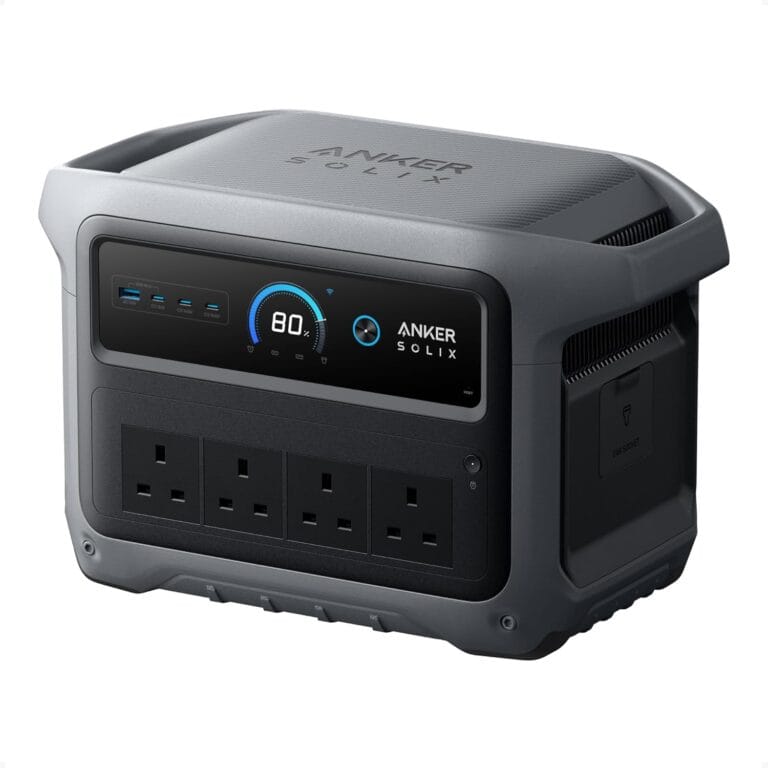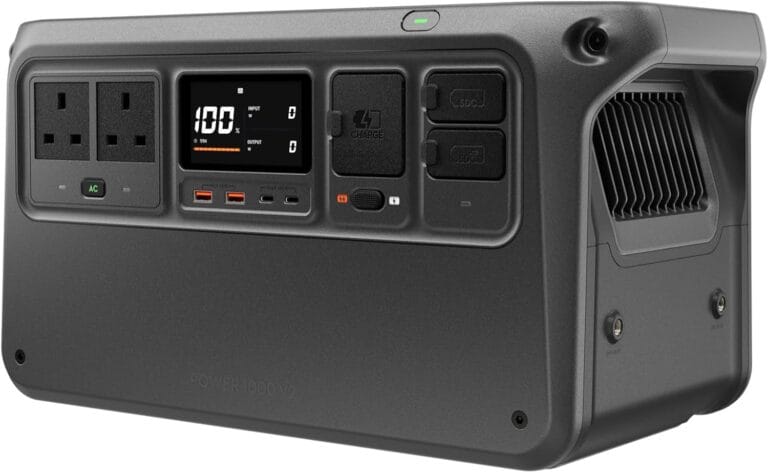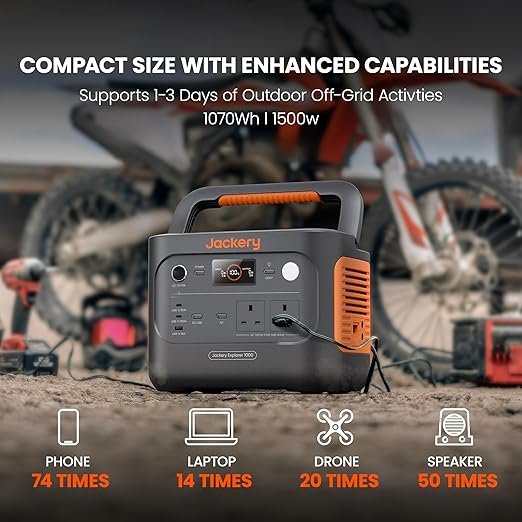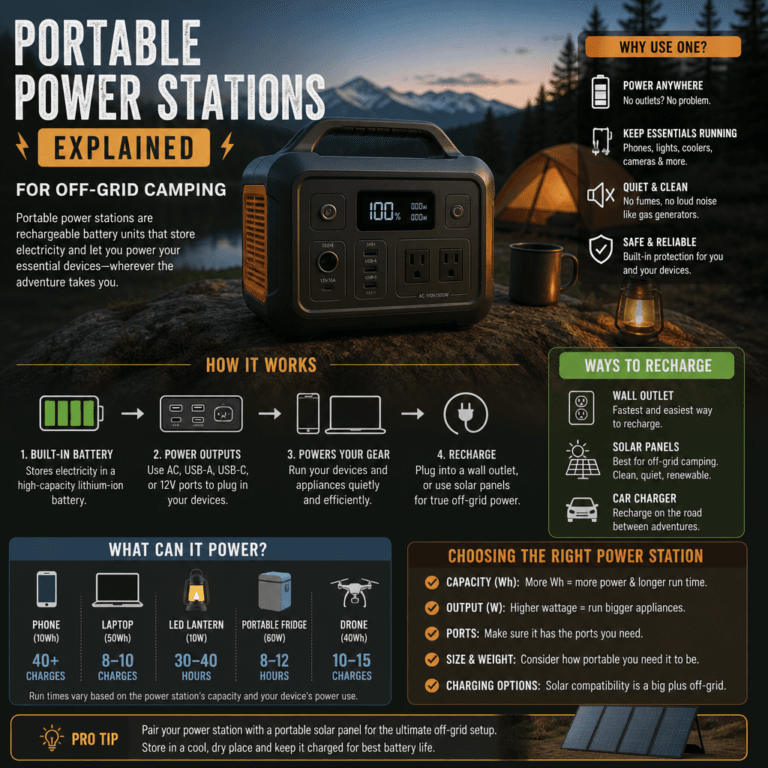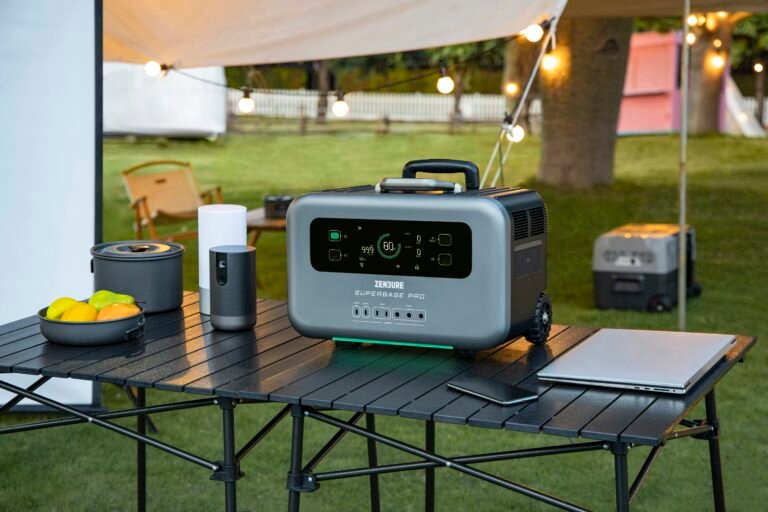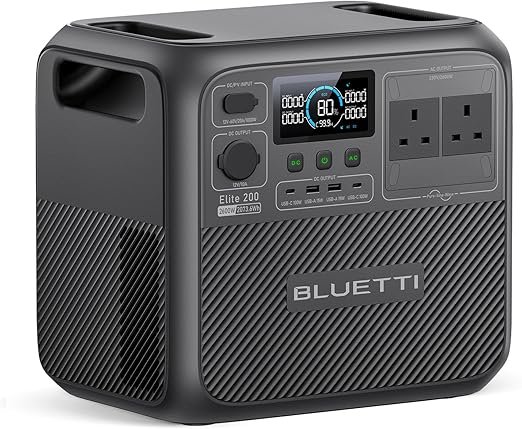
A camping power station is a portable battery with built-in sockets and charging ports, made to run your gear when there is no handy hook-up nearby. If you have ever sat on a dark pitch in the Lake District with a flat phone, a warm cool box and no spare socket in sight, the appeal becomes obvious very quickly.
What a camping power station actually is
A camping power station is, in simple terms, a larger and more capable version of a power bank. It stores electricity in a battery, then lets you use that stored power through different outputs such as plug sockets, USB ports and 12V ports. The whole point is off-grid convenience. You charge it up before the trip, or top it up from mains, your vehicle or solar, then take that power with you.
The big difference from a standard phone power bank is what it can handle. A power bank is mostly for USB gadgets. A camping power station can often run a laptop, a portable fridge, a fan, a TV or medical equipment for a while. Some can even run kitchen appliances, though that is where expectations often need bringing back down to earth.
Think of it like carrying a small energy cupboard instead of a single spare battery pack. Same basic idea, very different usefulness.
What a camping power station can run
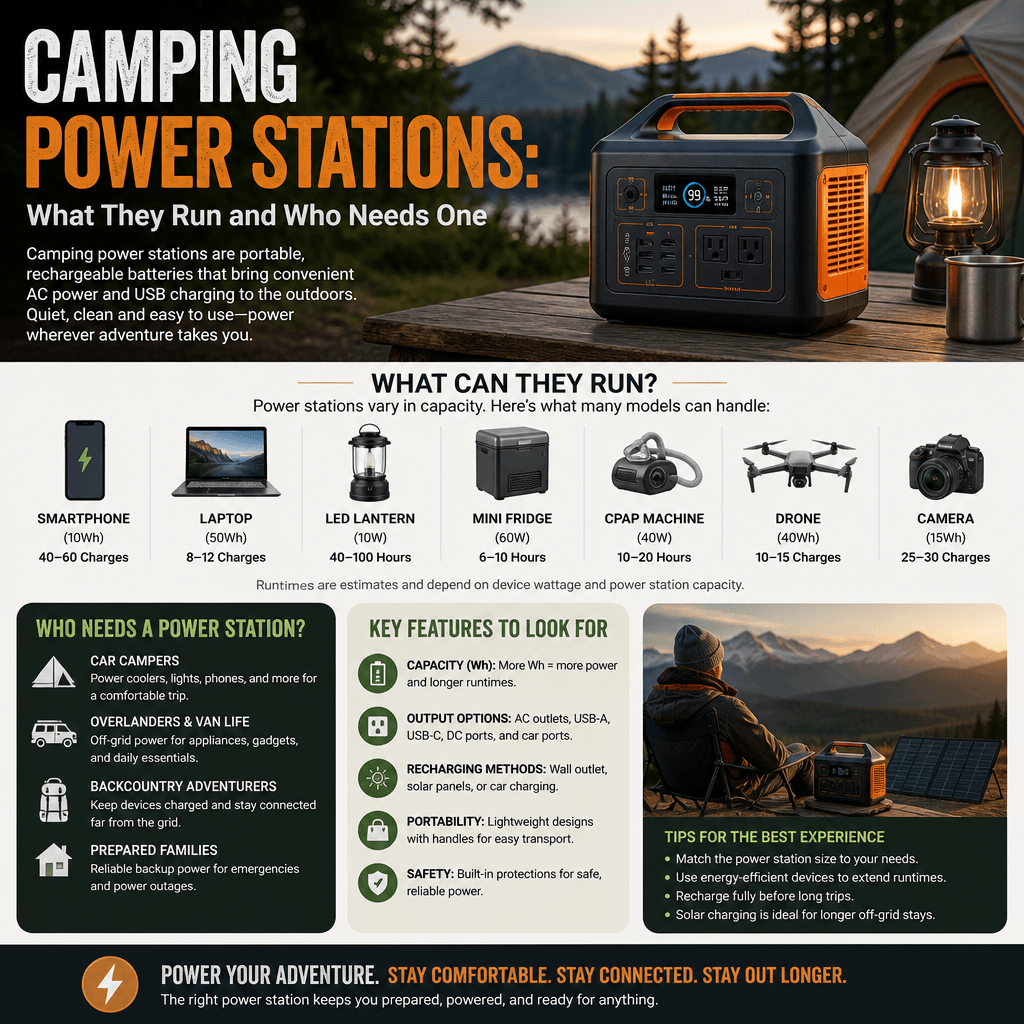
Here is the quick answer most people want: a camping power station can usually run phones, lights, tablets, laptops, fans, small TVs, routers, camera battery chargers, portable fridges and other low-to-medium draw kit. What it can run depends on three things: how much energy it stores, how much power it can deliver at one time, and how long you want the device to stay on.
That last part matters more than people expect. Running a light for six hours is easy. Running a kettle for ten minutes can be harder, because kettles demand a lot of power very quickly.
Small everyday kit
This is the easy stuff. Phones, tablets, head torches, smartwatches, Bluetooth speakers and rechargeable lanterns barely trouble most power stations. Even compact units can usually recharge this sort of kit multiple times without breaking a sweat.
That is why small stations make sense for basic camping. Your phone stays alive for maps and tickets, your lantern charges up, your speaker gets a top-up, and you are not playing musical chairs around the one campsite socket near the wash block. For light use, the experience feels a bit boring in the best way. It just works.
Mid-range camping and vanlife gear
This is where a camping power station starts to earn its place. Laptops, portable fridges, CPAP machines, Wi-Fi devices, electric blankets on low settings and 12V cool boxes are all common uses, especially in caravans, campervans and motorhomes.
Picture a normal touring evening. Your fridge is keeping food cold, your laptop is charging after a bit of work, your phone is plugged in, and a small fan is running because the van is stuffy. That is exactly the sort of mixed use a decent power station is built for. Not flashy, just genuinely useful.
High-draw appliances that catch people out
Here is the trap. Kettles, hairdryers, toasters, air fryers, microwaves and heaters pull a lot of power. Often a surprising amount. A travel kettle might draw 800W to 1000W. A normal hairdryer can go well beyond that. Small heaters and air fryers can jump even higher.
So yes, some larger power stations can technically run these. But often only briefly, and with battery levels dropping alarmingly fast. That is why so many camping power station plans fall apart at breakfast. Toast and a quick brew sound modest until the numbers show up.
The three numbers that decide what it can power
Product pages love throwing specs at you. The good news is that you only need to care about three of them most of the time: battery capacity, output wattage and surge power. Once those click, the rest gets much easier.
Battery capacity: how much stored power you get
Battery capacity is usually shown in watt-hours, shortened to Wh. This is the size of the energy tank. A 500Wh unit stores roughly twice as much energy as a 250Wh unit.
More Wh usually means longer runtimes, but also more weight, more charging time and more cost. That trade-off matters on a campsite. A 1,000Wh unit sounds great until you have to lift it out of a locker and carry it across wet grass.
Output wattage: what it can handle at once
Watts tell you how much power a device needs right now. Your power station has a maximum continuous output, which is the amount it can supply steadily. If your appliance needs 700W and the power station only supports 500W continuous output, it is not a match. Simple as that.
This matters even if the battery is huge. A big energy tank does not help if the tap is too small. That is why capacity and output are separate things. One decides how long. The other decides what, full stop.
Surge power and port types
Some devices need an extra burst of power when starting up. Fridges and compressors are common examples. That short burst is called surge power. A power station might cope for a second, then cut out if it cannot handle the startup demand properly.
Port types matter too. AC sockets are your normal plug sockets. A 12V car-style socket suits some fridges and cool boxes. USB-A is the older rectangular USB port. USB-C is usually the best option for newer phones, tablets and laptops because it can deliver power more efficiently and often much faster. The right connection is not just convenient, it can waste less energy as well.
How to tell if your gear will work
This is the practical bit. You do not need to become an electrician. You just need a quick checking habit before buying anything.
Check the label on the device
Look at the device itself, the plug, the adapter brick or the manual. You are looking for wattage, shown as W, or sometimes volts and amps. If you only see amps and volts, multiplying them gives the wattage.
For example, 12V and 5A means 60W. That number tells you what the device asks for. Once you have it, you are halfway there.
Match the device to the right output
Use the output that suits the device naturally. A laptop with USB-C charging is often better charged from a USB-C port than from a three-pin plug through its mains adapter. A 12V fridge may work best from a regulated 12V socket. Kitchen appliances nearly always need AC.
That matters because every conversion can shave off a bit of efficiency. Battery power turned into mains-style AC, then back down through a laptop charger, loses more than charging directly through USB-C. Not dramatic every time, but it adds up.
Estimate runtime without getting lost in maths
The rough formula is simple: watt-hours divided by watts gives hours. So a 500Wh power station running a 50W TV gives about 10 hours in theory.
Real life is lower because of conversion losses and because most units do not deliver every last watt-hour neatly. A safer working estimate is to knock a bit off. So that 10-hour example may be closer to 8 to 9 hours. A small fridge averaging 40W to 60W over time might make it through the night on a mid-sized unit, but not if you are also charging laptops, phones and camera batteries from the same station.
Who actually needs a camping power station
Not every camper needs one. But for some setups, it quickly becomes one of the handiest bits of kit you own.
You camp off-grid or use basic pitches
If you regularly stay on non-electric pitches, aires, farm sites, festival fields or simple stopovers, a camping power station makes immediate sense. No hook-up means every watt matters, and having portable stored power changes the feel of the trip. Your setup becomes less about rationing phone battery and more about actually enjoying the place you parked.
You want backup power without running the engine
A campervan or motorhome can charge devices from the vehicle, but idling the engine just to top up a phone or run a small fan is noisy, awkward and honestly a bit miserable. A power station gives you quiet backup power without that faff.
That is especially handy in the evening. Engine off, doors open, kettle on the gas, lights running, phone charging. Much nicer.
You carry gear with specific power needs
Some trips are light. Some are not. If you use a CPAP machine, carry drone batteries, shoot photos, work remotely, travel with kids and multiple devices, or depend on a compressor fridge, power stops being a nice extra and starts becoming part of the plan. In those cases, a power station solves a real problem. It is not just another gadget to stow badly.
When you probably do not need one
This is the part sellers tend to skip.
You only charge a phone and a light
If that is honestly all you need, a good USB power bank may be plenty. For a short weekend, especially with minimal gear, a camping power station can be overkill in both price and bulk.
You mostly stay on electric hook-up sites
If your caravan or motorhome spends most trips on serviced pitches, you may end up using a portable power station as an expensive spare rather than something you rely on. Nice to have, maybe. Necessary, probably not.
You expect it to replace a full onboard electrical system
A portable unit is useful, but it is not the same as a proper onboard setup with leisure battery, inverter, charging system and well-planned wiring. If your needs are heavy and constant, built-in power usually makes more sense.
Camping power station vs leisure battery, inverter and generator
These options overlap, but they are not the same tool.
Camping power station vs power bank
A power bank charges small USB gadgets. A camping power station can do that too, but also adds plug sockets, 12V outputs and enough capacity to run actual camping equipment. Once fridges, AC-powered devices or laptop charging enter the picture, the gap becomes obvious.
Camping power station vs leisure battery setup
A leisure battery setup is built into your caravan, campervan or motorhome. It is better for permanent, higher-use systems and often makes more sense if your vehicle is designed around it. A camping power station is portable, simpler and easier to add without modifying anything. That is the appeal. You can lift it out, use it in the awning, take it to another vehicle, or keep it as backup.
Camping power station vs generator
A generator still wins for very long runtimes and heavy-draw appliances. The catch is noise, fumes, fuel and campsite friendliness. A battery power station is far quieter and generally much easier to live with around other people. Inside a van or caravan, that difference matters a lot.
What to look for before you buy
A good spec sheet is nice. A good fit for your actual trips is better.
Capacity and weight
More capacity means more runtime, but also more kilos. If you move often, lift gear in and out a lot, or only stay away for a night or two, a smaller unit can be the smarter choice. If you stay put for days and run a fridge, laptop and lights, going larger starts to make sense.
Charging options
Look for mains charging, 12V vehicle charging and solar input if you want flexibility. That matters on touring holidays, especially if one day is spent driving through Cumbria and the next is a long static stop. Recharging options shape how useful the unit feels after day one.
Number and type of ports
Count what you actually need to run at the same time. Two AC sockets may be more useful than four USB-A ports you barely touch. A regulated 12V output can be brilliant for a fridge. Fast USB-C charging is one of the best features to have if you carry modern devices.
Battery chemistry, noise and lifespan
LiFePO4 is a battery type you will see often now. In plain English, it usually lasts longer over repeated charging cycles and is popular for good reason. Also pay attention to fan noise, general build quality and expected lifespan. Flashy extras sound fun online, but quiet operation and durability matter more once you are actually using the thing outdoors.
Common mistakes and misconceptions
Most disappointment starts with one bad assumption.
“If it has a plug socket, it will run anything”
No. A plug socket only means you can physically connect the device. It says nothing about whether the power station can supply enough wattage or keep it going for long. A hairdryer will teach this lesson brutally fast.
“Bigger is always better”
Not if it is too heavy to move comfortably, too expensive for your needs, or too slow to recharge during short trips. Buying the biggest model can be like taking six folding chairs for a one-night stop. Technically useful, practically annoying.
“Solar panels will keep everything topped up all day”
Sometimes, yes. In perfect summer conditions, with enough panel input and no shade, solar can be brilliant. In the UK, cloud, tree cover, low winter sun and short days can change that fast. Solar is useful, but it is not magic.
Quick examples for different camping setups
A few real-world scenarios make this much easier to picture.
Weekend caravan trip on a non-electric pitch
If you want to run lights, charge phones, keep a portable TV going for the evening and support a cool box, a modest mid-sized unit often makes sense. You do not need a monster. You need enough capacity for one or two evenings without turning every cup of tea into a battery calculation.
Campervan touring with work and charging needs
If your trip includes a laptop, camera batteries, phone charging and a small fridge, a larger unit starts to justify itself quickly. Charging from the vehicle while driving, then topping up on mains when available, creates a simple rhythm that works well for a few days on the road.
Motorhome backup for essentials
Even with an onboard system, a power station can be handy backup. If your main battery is busy, limited or temporarily unavailable, a portable unit can keep key gear alive without touching the core setup. That is especially useful for medical devices, communications and fridge support in a pinch.
Frequently asked questions about camping power stations
A few uncertainties tend to come up every time.
Can a camping power station run a kettle or microwave?
Sometimes, yes, but usually not for long and often not efficiently enough to make much sense. High-draw appliances drain batteries fast.
How big a camping power station do you need?
Start with what you want to run, how many hours you want it running, and whether you can recharge each day. That gives you a far better answer than copying somebody else’s setup.
Are camping power stations worth it?
Yes, absolutely, if you camp off-grid, carry device-heavy kit or want quiet backup power without using the engine. Less so if you only stay on hook-up sites or barely charge more than a phone.
Can you charge one from solar panels or your vehicle?
Many models support both. Charging speed depends on the station itself, the solar input limit, the size of the panel and, with vehicle charging, how the unit accepts power while driving.
Is it safe to use inside a caravan or campervan?
Battery power stations are generally suitable for indoor use when used properly, unlike fuel generators. Keep cables tidy, follow the manufacturer guidance, and make sure vents are not blocked.
The simple way to decide
If your trips regularly involve non-electric pitches, multiple devices, a portable fridge or any gear that genuinely matters, a camping power station is probably worth having. If your needs stop at a phone, a lamp and the odd top-up, keep it simple and stick with a good power bank.
That is the trick: buy for the trip you actually take, not the fantasy version with a toaster, air fryer and salon-grade hairdryer running in a field. Try adding up your usual kit for one evening away. Once you do that, the right size becomes much easier to spot.