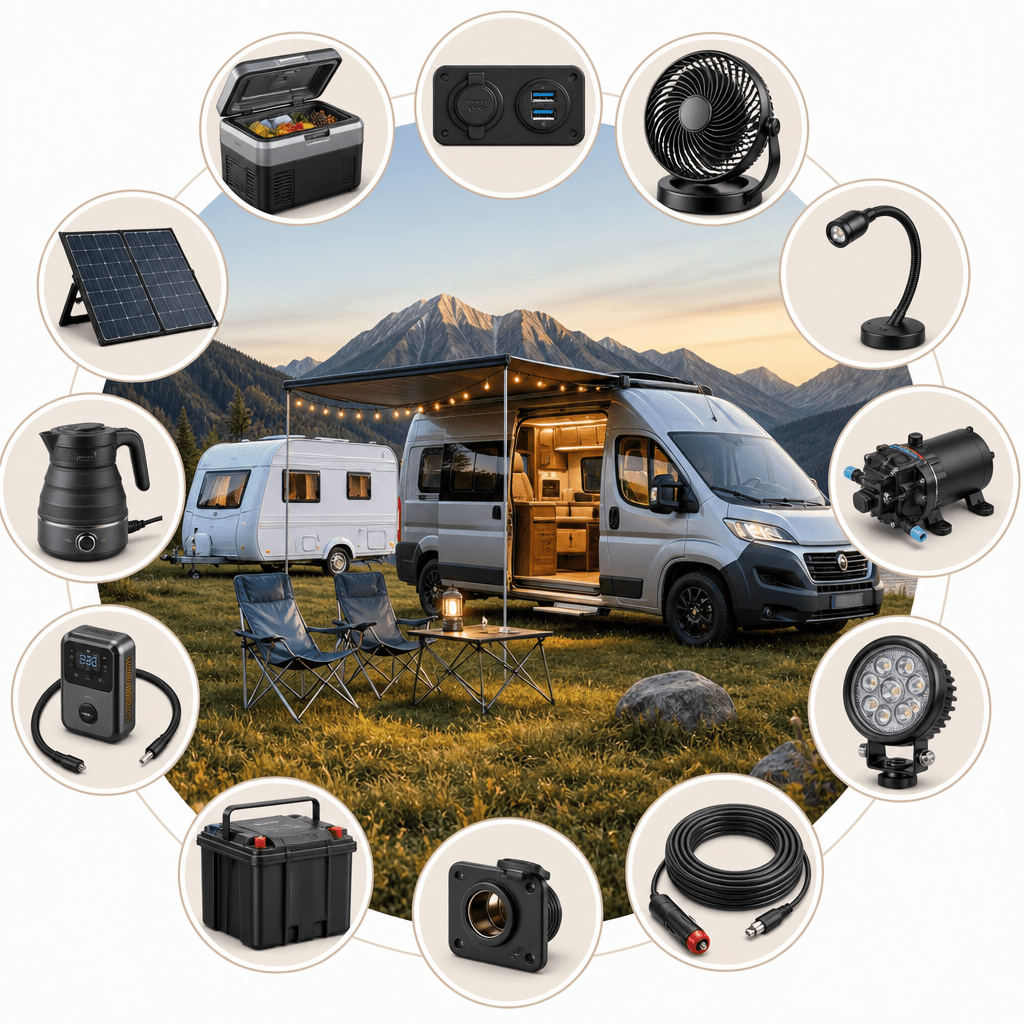
There is nothing like pulling up at a beautiful spot, switching everything off, and still having lights, hot drinks and cold food ready to go. That sweet spot between comfort and freedom is exactly where 12 volt camping gear shines.
Most caravans, campervans and motorhomes have a built in 12 volt system designed for life away from a hook up. Instead of relying on fragile mains leads or hunting for sockets, you can tap into your leisure battery, the dedicated battery that quietly keeps your living area powered while your starter battery is reserved for getting you moving again.
From fridges and USB chargers to heaters, pumps and fans, the right 12 volt accessories let you camp comfortably both on grid and completely off grid. They run directly from your vehicle’s low voltage system, which is generally safer and more efficient for camping than trying to power everything from 230V mains.
There are a few basics to keep things safe and reliable. Every circuit should be fused correctly. Cables need to be the right thickness for the current they carry. Sockets and splitters should not be overloaded with more gadgets than they are designed for. Most importantly, you need a rough idea of your battery capacity and how quickly different accessories will drain it.
This guide walks through the most useful 12 volt accessories for caravans, campervans and motorhomes, how much power they use, and how to choose gear that suits your setup. By the end, you will be ready to build a comfortable, efficient 12 volt campsite of your own.
Understanding your 12 volt system and cigar lighter sockets
Your 12 volt system is the backbone of life on board. In most vans and caravans you will see a few different ways to tap into it: the factory fitted cigar lighter socket in the cab, extra 12 volt “DIN” or cigar style outlets in the living area, built in USB sockets, and sometimes a separate portable power station with its own battery and outputs. All of these draw from a battery somewhere, so it helps to know which is which.
Your starter battery is for cranking the engine. It delivers a big burst of power for a short time and then is quickly recharged while you drive. It does not like being drained deeply. Your leisure battery is designed for slow, steady use to run lights, pumps and accessories. As a rule, anything you use while parked should come from the leisure battery or a power station, not the starter battery, so you do not risk a non starting engine in the morning.
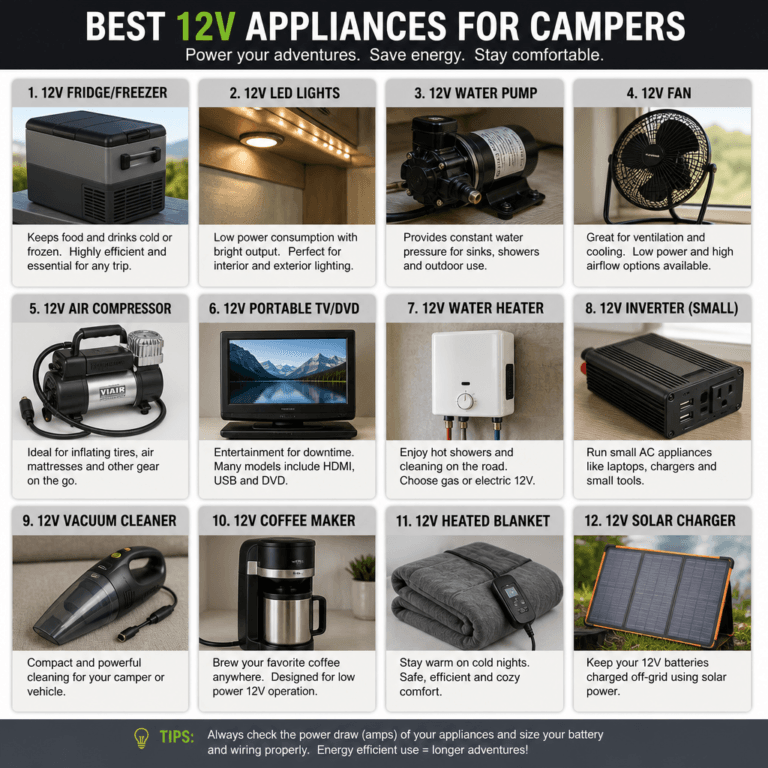
Typical 12 volt gadgets vary a lot. A phone charger might use 5 to 15 watts, a compressor fridge 30 to 60 watts when running, and a kettle 120 to 300 watts or more. Off grid or overnight, those differences add up, so always check the label and think in hours, not minutes.
Use cigar lighter sockets with care. Avoid stacking cheap plastic splitters, choose quality adaptors with proper fusing, and use short, thick cables to reduce voltage drop and heat. If a plug or socket ever feels hot or loose, unplug it and sort the issue before carrying on.
Plug in comfort 12 volt kettles, coffee makers and electric blankets
A hot drink and a warm bed make a huge difference on a chilly evening, and 12 volt accessories can help, as long as you understand their limits.
A 12 volt kettle is convenient, especially while driving, but it draws a lot of power for a long time. A typical 12 volt kettle might be 120 to 200 watts, so even a small amount of water can take 15 to 30 minutes to boil. They are safer in transit than a pan on the hob, but they can flatten a battery if used off grid. A gas kettle is much quicker and usually the better choice when you are parked up.
12 volt coffee makers come in a few styles. Pod based and espresso style units often pull 120 to 180 watts, and some briefly spike higher when heating water or building pressure. Drip style coffee makers can be a little gentler, but still put a steady load on your leisure battery. Most are best used while driving or when you have hook up or generous solar.
For winter, 12 volt electric blankets and heated throws are a game changer. Look for models with multiple heat settings, a timer, and automatic cut off. A typical blanket might draw 40 to 70 watts on high, so it is fine for an hour or two in the evening, but you should not leave it on full all night. Pre warm the bed, then drop to low or switch off once you are cosy.
Whenever you can, heat water on gas first, then use 12 volt gear to keep things warm, not to do all the heavy lifting. Reserve high draw heaters and kettles for when the engine is running, the alternator is charging, or your battery and solar setup are comfortably up to the job.
Cool, fresh food 12 volt compressor fridges and coolers
Keeping food safe and drinks cold makes a huge difference to life on the road. There are three main fridge types you will see for camping, and they are not all equal when it comes to 12 volt use.
Compressor fridges are the star of the show for vans and caravans. They work like a household fridge, with a compressor cycling on and off, and can easily reach and hold proper fridge temperatures, even in warm weather. They cool quickly and use power in short bursts rather than constantly, so they are usually the most efficient option on 12 volt and a great match for solar.
Thermoelectric coolers are the cheap, simple ones that just “cool below ambient.” They can take the edge off but struggle in hot weather and run continuously, which can flatten a battery surprisingly fast. Three way absorption fridges can run on gas, 230 volt or 12 volt, but on 12 volt they are usually meant for use while driving, not for long off grid stops.
You can choose from portable compressor cool boxes, that move between cab, awning and pitch, or built in units with front doors or top opening lids that suit fixed camper and caravan kitchens. Measure carefully, think about door swing, ventilation space and how much food you actually carry.
To get the best from any 12 volt fridge, pre chill it and your food at home on mains, use an insulated cover if available, keep it shaded with good airflow around the vents, and manage your battery: avoid leaving it on max, pair it with adequate solar, and check it is wired with suitable cable and fuses.
Stay charged and connected 12 volt USB gadgets and satnavs
A good 12 volt setup keeps your gadgets topped up and your navigation clear, without a tangle of cables across the cab.
Common 12 volt USB accessories include phone and tablet chargers, clip on fans for stuffy nights, flexible LED reading lights, camera and drone battery chargers, Bluetooth FM transmitters or receivers to get audio into an older stereo, and USB powered speakers. Most draw very little power, so they are ideal for using on hook up or off grid.
It is worth paying for a quality 12 volt USB adaptor. Look for recognised fast charge standards like USB Power Delivery (PD) or Qualcomm Quick Charge, multiple outputs, and a decent total wattage rating. Cheaper adaptors often overheat, charge slowly, create radio interference, or fail early, which is the last thing you want mid trip.
Dedicated 12 volt satnavs designed for caravans and motorhomes are another useful upgrade. They can take account of vehicle height, weight and length, warn about low bridges and narrow roads, and often include campsite POIs and a clear, bright display that stays visible even in sunshine. That means less stress on unfamiliar routes and less reliance on patchy mobile data.
Mounting and cable management matter for safety. Use solid, vibration resistant mounts fixed to the windscreen or dash where they do not block your view. Run charging leads around the edge of the cab with clips or trunking, not across gear levers or pedals, and angle screens to avoid glare at night. A tidy cab is more comfortable, and keeps your focus on the road.
Cleaning on the road 12 volt vacuum cleaners and USB window vacs
A small 12 volt vacuum cleaner is one of those unglamorous bits of kit that quickly proves its worth. Look for decent suction figures rather than just “high power” marketing, a cable long enough to reach from the socket to every corner of the van, and a couple of useful attachments, such as a crevice tool for seat runners and a brush head for upholstery and mats. A transparent, bagless dust container makes it easier to see when it needs emptying and avoids hunting for special bags on the road. Washable filters are a bonus for long trips.
In many caravans and motorhomes, a wired 12 volt vac is more practical than a tiny cordless hand vac. Cordless models often have short run times and lose suction as the battery ages. A plug in cleaner can usually run as long as your leisure battery allows, so you can tackle a full interior clean after a muddy walk without worrying about recharging first.
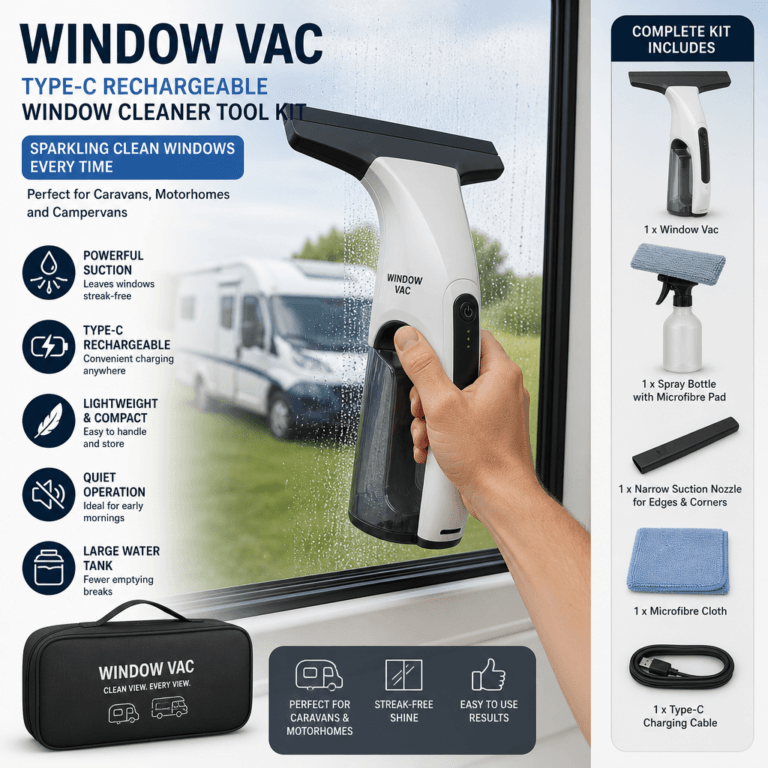
For windows and damp, a USB rechargeable window vacuum earns its place. These compact squeegee vacs remove condensation from glass, tiles and shower screens, collecting the water in a small tank. They are brilliant on cold mornings when the inside of the windscreen drips and the van feels clammy.
Make condensation control part of your daily routine. In the morning, crack a roof vent or window, run the window vac over glass and hard surfaces, then empty the tank outside. Combine this with good airflow, using extractor fans when cooking and hanging wet gear in one ventilated spot, to keep damp under control and the van feeling fresh.
Choosing and using 12 volt accessories wisely
Choosing and using 12 volt accessories wisely starts with understanding what each item draws from your battery.
Check the label or manual for watts (W) and amps (A). On 12 volt systems, you can roughly convert:
Amps = Watts ÷ 12.
If a kettle is 150 W, it pulls around 12.5 A. Run it for 15 minutes and you have used a noticeable chunk of a 100 Ah battery. Compare that with a 5 W LED light at under 0.5 A, which you can run for hours.
Prioritise low draw essentials that are on for long periods: LED interior lighting, USB charging for phones and tablets, and a good 12 volt compressor fridge. High draw luxuries like kettles and coffee makers are best kept for when you are on hookup, the engine is running, or your solar and battery bank are sized to cope.
Use extension leads and multi sockets that are properly rated for 12 volt use, with thick cable and solid plugs. Keep cable runs as short as practical to reduce voltage drop, avoid coiling long leads tightly, and never daisy chain cheap splitters. Warm or soft plugs are a warning sign, unplug and investigate.
A few small extras make life much easier. An inline voltmeter in a socket gives a quick health check of your battery. Low voltage cut off devices protect your battery from being dragged too low. Proper battery monitors show real time amps in and out plus state of charge, which is invaluable when balancing solar, driving time and your growing collection of gadgets.
Bringing it all together a comfortable, efficient 12 volt campsite
A well planned 12 volt setup quietly does a lot of heavy lifting for your trips. It keeps food fresh, phones charged and the living space warm, lit and welcoming. Get it right and you spend less time worrying about batteries and more time enjoying where you have parked up.
You do not need everything at once. Start with the basics that make the biggest difference: a reliable 12 volt compressor fridge or cooler, good LED lighting and safe USB charging for phones and tablets. Use a simple battery monitor or voltmeter to learn how your system behaves through a typical day and night. Once you understand your power use, add luxuries like a 12 volt coffee maker, heated throw or extra fans if your battery and solar can support them.
Electric kit is only one part of the comfort puzzle. Gas still excels for fast boiling and cooking, and good insulation and thermal blinds reduce the need for heating and cooling. Simple routines help too, like pre chilling food at home, managing condensation each morning and switching off non essential loads overnight.
Take a few minutes to look over your current gear. Check what genuinely earns its place on board, what needs an upgrade and where a better cable, socket or monitor would improve safety. With a thoughtful mix of 12 volt equipment, gas and sensible habits, your caravan, campervan or motorhome becomes a comfortable, efficient home on wheels.
Clear takeaway: start simple, power the essentials well, then build up your 12 volt setup as you understand your needs, and every trip will feel easier and more relaxed.
Why Every Camper Van Needs a USB Window Vac
Discover how a compact USB Type C window vac stops campervan condensation, clears fogged glass fast and keeps your motorhome fresh and dry.
12 Volt Electric Blanket For Camping
Discover how 12V and 24V heated car blankets deliver safe, consistent warmth, comfort and versatility for winter driving, camping and outdoor travel.
Best Motorhome Sat Navs for UK and Europe
Compare the best motorhome sat navs for UK and European touring, with practical advice on vehicle profiles, routes, maps, alerts and screen size choices.
Best 12V Appliances for Campervan Life
Find the best 12v appliances campervan owners actually use, from fridges to kettles, with practical tips on power, space and everyday comfort.
Submersible Water Pump 12 Volt Stainless Steel
Discover how 12V stainless steel submersible water pumps work, their corrosion resistance, durability, and key benefits for demanding applications.